I Spent $2,847 on Courses Before I Found the Missing Engine
Four programs. Three years. Almost nothing to show for it — until I finally understood why they all failed at the same hidden point.
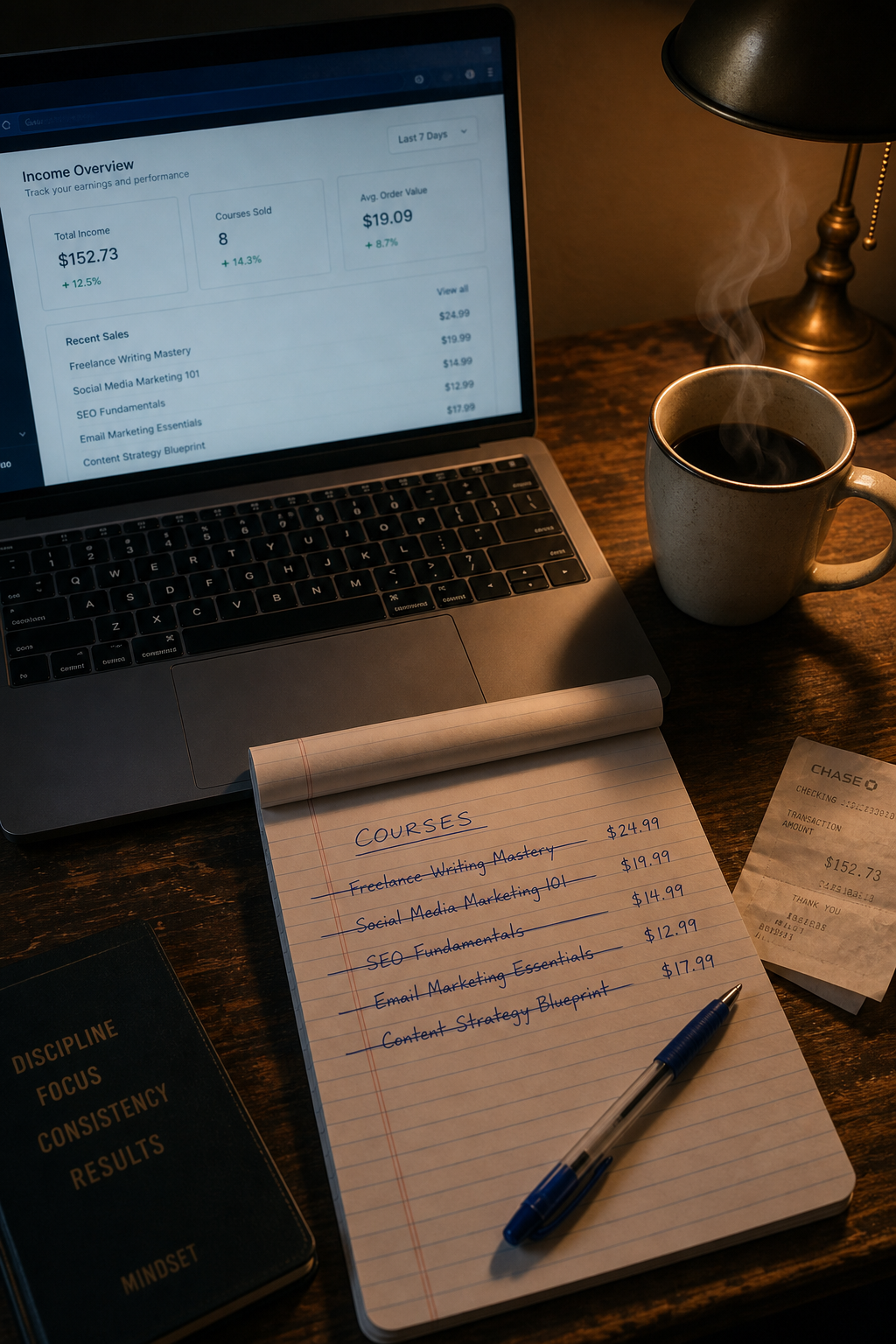
Three years of late nights. Most of them going nowhere. Then one Tuesday that changed the math.
Let me tell you the exact number. Not a round one. $2,847. That is what I spent across four online income programs between early 2021 and the end of 2023. I kept it in a spreadsheet because I am the kind of person who needs to believe he is being methodical.
Dropshipping course — $297. Amazon FBA bundle — $497. Faceless YouTube automation training — $197. ClickBank affiliate program — $67. A PLR reselling package I bought at 11 PM on a Tuesday I do not need to name — $37. Some smaller things I have blocked out. And the big one, the one I talked myself into after watching a man’s income report video for forty minutes — $997. I told my wife it was “business research.” She did not press. The silence afterward was worse than a fight would have been.
What did I make? Scattered commissions on a few things. An Amazon account that got flagged. A YouTube channel sitting at 187 subscribers with $14.62 in ad revenue after eight months of consistent uploads. I made back maybe $310 total across everything. On paper, I lost $2,537. The real cost was higher, but that is the dollar figure.
“I kept telling myself I was one system away from it clicking. What I could not name was why every system failed at the exact same point — and why the reason was identical each time.”
I was not passive about any of it. I watched the modules. I took notes in a second tab. I built the pages, wrote the follow-up sequences, set the funnels live. I did the work. Every time, I arrived at the same wall and stopped cold — and I still did not have a name for what the wall actually was.
The wall is traffic. It is always traffic.
Not “traffic might be a problem if other things don’t work out.” Traffic is where everything terminates. Every course I bought taught me to build the destination — the product, the page, the offer, the funnel. Not one of them credibly solved how a person with no existing audience, no ad budget, and no established platform was supposed to get eyes on any of it in the first place. The affiliate commission was real. The course was real. The product was real. And then you sit staring at zero visits for three weeks and quietly close the tab.
The second problem nobody talks about honestly: the gap compounds. Every month you do not build traction, the environment shifts. The platform that worked last year updates its algorithm. The niche that was viable six months ago is now saturated. You come back after two weeks away — job pressure, kids, actual life — and the context you built is gone. You are not picking up where you left off. You are restarting in a faster-moving environment with stale assets.
Three years in, $2,847 down, I reached the specific low point I think a lot of people in this space recognize: I genuinely could not tell whether I was not disciplined enough, not smart enough, or just kept picking the wrong vehicle. That uncertainty is more corrosive than the money lost. The money is survivable. The self-doubt about whether you are capable of this — that one follows you around. My wife had stopped asking what I was working on at night. The silence was its own answer.

In January I bought one more thing. I want to be honest about how that felt: not hopeful. I was past hopeful. I had been hopeful with every previous one. I clicked the button the way you take a medication you are not sure is going to work — not because you believe it, but because the alternative is sitting still while the situation gets worse.
What I found inside answered the question I had never been able to phrase correctly. Not “why isn’t my funnel converting better?” The real question was: why does reaching consistent traffic always require either an existing audience, serious ad spend, or both? Every course I had bought assumed I had one of those two things and did not. None of them solved it. They all sold destinations without solving the route.
The AI Creator system is built around a different architecture. I am calling it the Missing Engine because that is what it was — not a better version of what I had tried, but the component that would have made every other system actually work.
Named Mechanism
The Demand-First Content Engine
Every system I had bought asked me to push content toward an audience I had to build first. The Demand-First model inverts that entirely. AI maps existing search demand — real gaps where people are actively looking for content right now — and builds assets specifically to fill those gaps. You are not generating traffic. You are positioning inside traffic that already exists and is looking for an answer.
No audience required on day one. AI identifies demand pockets where content supply is thin relative to what people are already searching for. You fill the gap. The algorithm surfaces you because you are the answer to an existing question — not because you spent months building a following.
AI handles production — you supply direction. The part that broke me every time was volume. Writing, formatting, and publishing at the pace the algorithm rewards requires either full-time hours or serious money. AI handles production. You supply topic selection, editorial judgment, and the instincts that three years of research in this space actually gave you — even if it felt like spinning your wheels.
Assets compound instead of expiring. Paid ads stop the moment you stop funding them. Content assets keep earning. Month three outperforms month one on the same piece — not less. Everything you deploy is an accumulating asset, not a recurring cost.
The payout that made me stop second-guessing: $1,452.80 — a single bank transfer from affiliate commissions generated through the AI content assets I had deployed over six weeks. Not a round number. Not a summary. A bank confirmation with a transaction date, a reference number, and an amount that would have taken me three months of driving Amazon deliveries on weekends to match.
[Bank transfer confirmation — uploaded by vendor, viewable on the offer page below]
“I had tried FBA, affiliate, even dropshipping. Probably $1,800 in courses total. I know what a purchase confirmation email looks like and I know how it feels when nothing converts. I went through the AI Creator modules over a weekend, deployed my first content asset on a Saturday, and got a $67 commission by week two. I am four months in now. Last month was $894. The traffic problem just stopped being a problem.”
— Marcus W., warehouse shift supervisor, Ohio · former FBA and ClickBank affiliate buyer
No paid ads. No email list. No existing social following. The content I deployed in month one was still generating commissions in month three without any additional work on those specific assets.
[Dashboard screenshots available directly on the offer page]

“I’ve bought courses that all claimed to be different. How is this one actually different — mechanically different — and not just marketed differently?”
Every course I bought before assumed I already had either an audience or a budget to pay for reach. None of them solved the cold-start traffic problem at the structural level — they treated it as something I was supposed to figure out separately. The Demand-First engine solves it at the architecture level, not in an optional module tacked onto the back end. It is a different model, not a better-looking version of the same one. I recognized the difference immediately because I had spent three years hitting the wall the other model creates.
“I start things. Life interrupts. I come back and the thread is gone and nothing is working. What makes this any different from the folder of half-watched modules I already have?”
Sessions are 45 minutes. Each one produces a deployable asset that keeps earning whether or not you open the platform again for two weeks. This is not a 12-week curriculum where skipping week four breaks everything that follows. I ran this alongside a full-time job on a non-linear schedule — sometimes daily, sometimes with long gaps. The content I deployed early kept earning through the gaps. The model is designed for interrupted schedules, not ideal ones.
“The income screenshot could be cherry-picked. The person posting it could be on the vendor’s launch team. I’ve seen this before.”
That is the right question. I asked it too. What moved me was the specificity of the number. $1,452.80 is not a number a marketing team invents. $1,500 is. $2,000 is. The odd amount with the decimal point is what a real bank transfer looks like — it has a date, a reference number, an originating account. The WarriorPlus platform also adds its own verification layer. I was skeptical for the same reason you are. The specificity is what pushed me past it.
I am not going to tell you this is the last thing you will ever need to buy. I do not know your situation, your niche selection instincts, or how consistent you will be in the first eight weeks. What I can tell you is that I spent nearly three years identifying the exact point where everything collapsed — and this is the first system that answered that specific problem with a mechanism I can actually see working in my own account right now, with month-by-month numbers that compound instead of plateau.
The page below walks through how the Demand-First engine works in plain terms: the AI tool, the content model, the commission structure, the actual cost to start. It is not a 40-minute VSL you have to sit through before they reveal the price. You will recognize the mechanism immediately if you have spent any time in this space — and you will understand, as I did, why it solves the problem the others did not.
The mechanism that explained every failure — and then removed it.
See exactly how the Demand-First engine works, what a first session produces, and what the entry cost looks like. No email required on this page. Goes directly to the offer.